

Learning to read begins at home through everyday parent-child interactions, long before children attend school. Your continued support of literacy development throughout elementary school positively affects your child's reading ability. We are pleased to provide these Family Activities with easy-to-follow instructions to help your child practice foundational reading skills. We invite you to view the short Family Videos for tips on how to use the activities to help your child grow as a reader. Using the Family Activities at home can help your child develop language, link sounds to letters, blend letters and word parts to read and write words, and read for understanding.
Second Grade: Developing Language
Talking While You Read Informational Text
Expose your child to the formal language that is common in books and in school.
Having a conversation about a book will develop your child's vocabulary and build knowledge about the topic of that book. Whether you are reading a fairy tale, a picture book, an informational book, or any other text, you can engage in a discussion as you enjoy reading together.
Informational books contain factual information, like an article about the water cycle, a book about animals that hibernate, or a biography, which is a description about someone's life. Reading and talking about informational books can help your child develop their language and improve skills like problem-solving.
It is best to choose books about topics which are interesting to your child. You can read books from your home or borrow a book from your child's classroom library, school library, or the public library. You can also access books on laptop computers, tablets, digital reading devices, and smartphones. Websites such as Project Gutenberg provide free access to books and mobile formats especially for smartphones. Don't forget to look through your smartphone's app store for free apps containing books for children.
To talk while you read, use a tool called CROWD to ask different types of questions to prompt a discussion about a book:
- Completion Ask your child to complete a sentence or a phrase from a book you are reading.
- Recall Ask about details of what you read.
- Open-ended Ask about a picture in the book.
- W- Ask wh questions that begin with Who, What, Where, When, or Why.
- Distancing Ask questions that relate something in the story to your child's life.
See the Talking While You Read Tri-folds for how to use CROWD. The texts in the tri-folds are arranged from easiest to most difficult (Tri-fold 1, Tri-fold 2, and Tri-fold 3).
Talking While You Read Using CROWD
Key Points About the Video
- Mom encourages her son to point to the words as he reads because she knows that his accuracy is better when he points to the words.
- Mom asks different types of questions using CROWD (Completion, Recall, Wh, and Distancing).
- Mom encourages son to look back at the text to find the answers to the questions.

Talking While You Read Trifold 1
The Talking While You Read Trifold includes an overview of how to use CROWD. There is also a text with questions placed where they are most helpful to prompt your child.

Talking While You Read Trifold 2
The Talking While You Read Trifold includes an overview of how to use CROWD. There is also a text with questions placed where they are most helpful to prompt your child.

Talking While You Read Trifold 3
The Talking While You Read Trifold includes an overview of how to use CROWD. There is also a text with questions placed where they are most helpful to prompt your child.
Books to Share
Take turns reading or listen to your child read. Stop after each page or so to ask questions to prompt discussion.
- Charlotte the Scientist is Squished by Camille Andros
- The Magic School Bus Inside a Beehive by Scholastic
- There's No Place Like Space: All About our Solar System (Cat in the Hat's Learning Library) by Tish Rabe
- Pop! by Meghan McCarthy
- Smart About Chocolate: A Sweet History by Sandra Markle
Talking While You Read Stories
Stories are written for enjoyment and are typically not true. An example of a story is The Three Little Pigs. Stories often include characters, a setting (or where the story takes place), a problem, and a solution. The characters in The Three Little Pigs are the three pigs and the wolf. The setting is at the pig's houses. The problem is the wolf blows down the pig's houses. The solution is all the pigs live in the strongest house made of bricks, which the wolf cannot blow down. Reading and talking about stories can help your child develop their understanding about how stories are organized and can improve comprehension.
It is best to choose books about topics which are interesting to your child. You can use books from your home or borrow a book from your child's classroom library, school library, or the public library. Also, keep in mind that you can access books on laptop computers, tablets, digital reading devices, and smartphones. Websites such as Project Gutenberg provide free access to books and mobile formats especially for smartphones. Don't forget to look through your smartphone's app store for free apps containing books for children.
Talking While You Read Stories (The Day the Crayons Quit)
Key Points About the Video
- Mom and son take turns reading.
- Mom facilitates a conversation at the end of the book by asking questions about the story and using the bookmark as a resource.
- Mom asks questions that refer to typical characteristics of any story (character, setting, problem, and solution).
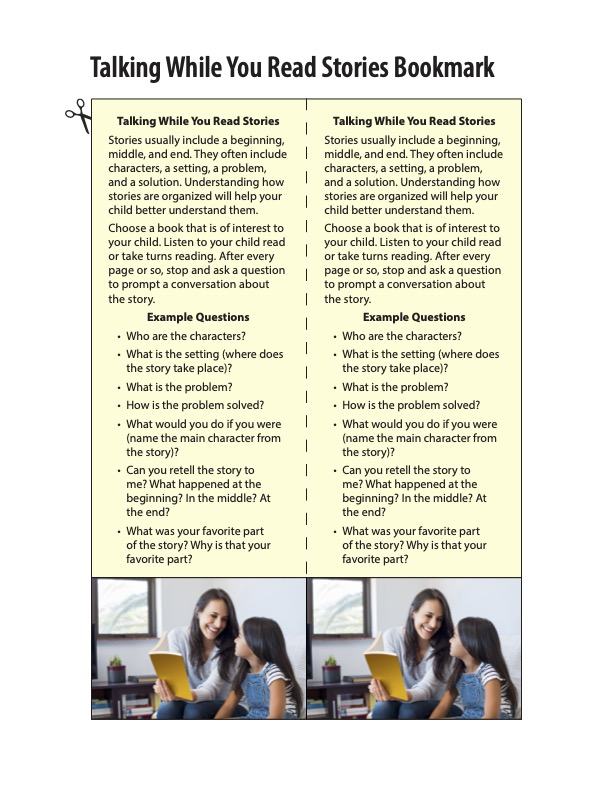
Talking While You Read Stories Bookmark
Use the Talking While You Read Stories Bookmark to ask questions about the characters, setting, problem, and solution while reading a story with your child.
Supporting Oral Language and Vocabulary Development
Oral language is the way we communicate with others through speaking and listening. Vocabulary knowledge is a crucial part of oral language and includes understanding the meaning of words, how to use them, and how to pronounce them.
Oral language practice will help your child expand his or her vocabulary. Children with strong oral language skills and larger vocabularies typically become better readers. The best ways to give your child a strong foundation for learning to read are to read to, talk to, and listen to your child every day. Talk about people you know, places you go, and experiences you have together. Writing with your child also helps with oral language development.
- Ask questions that require more than a yes or no answer. For example, instead of asking, "Did you have a good day?" ask, "What was your favorite part of school today?" Continue to ask questions about your child's response. If the answer was "Recess," ask, "Who did you play with?" "What did you do?" "How do you play that game?"
- When you speak with your child, model speaking in complete sentences and providing details. Use the words your child says and expand on them. For example, if your child points to a car and says, "Yellow car!" say, "That is a bright yellow car that is moving quickly! Where do you think that person is going?"
Talking and Writing in the Kitchen
Key Points About the Video
- Mom continually uses the word round to help her daughter build vocabulary.
- Mom restates her daughter's answers in complete sentences to model oral language skills.
- Mom uses the Talking While You Read Bookmark to remind herself of kinds of questions to ask
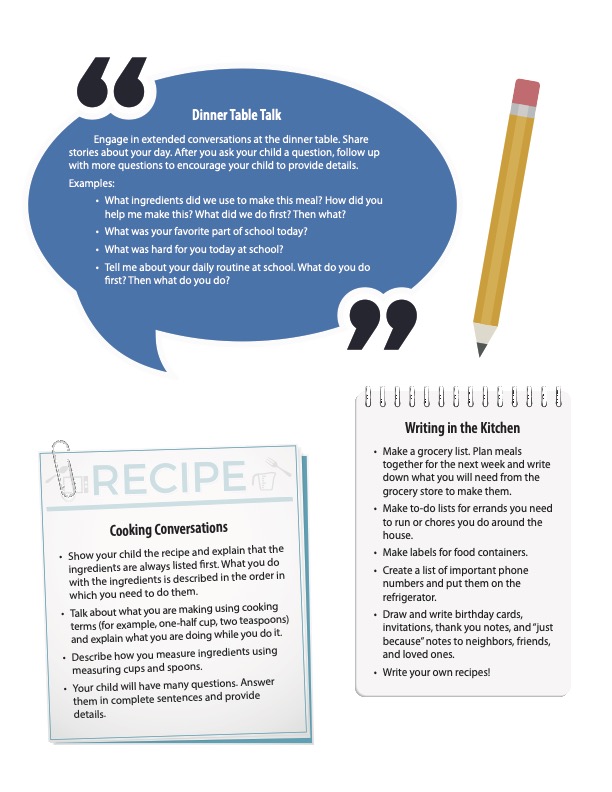
Talking and Writing in the Kitchen
Use these questions, activities, and conversation starters to have fun while you talk and write in the kitchen.

Grocery Shop Talk
Use this activity to make a grocery list with your child. Ask your child questions and engage in conversations while you grocery shop together.
Second Grade: Linking Sounds to Letters
Linking Sounds to Letters
Help your child link sounds in speech to letters in print.
Linking individual letter sounds to letters is typically achieved by second grade. However, if a child needs practice with pulling apart and putting together sounds in spoken words and linking sounds to letters in print (M says /m/), please visit Supporting Your Child's Reading at Home, First Grade: Linking Sounds to Letters.
Second Grade: Blending Letters, Recognizing and Reading Words
Blending to Read Words
Blending is the ability to put letter sounds together to read a word. To read a word, children must know the sounds the letters represent in the word and be able to blend those sounds to come up with the correct word. For example, after children know the letter sounds /f/ for f, /i/ for i, and /sh/ for sh, they learn to blend those sounds together to read the whole word. When they see the word fish, they are able to say, "/f/ /i/ /sh/, fish." We call this, blending because you are putting sounds together to read a word.
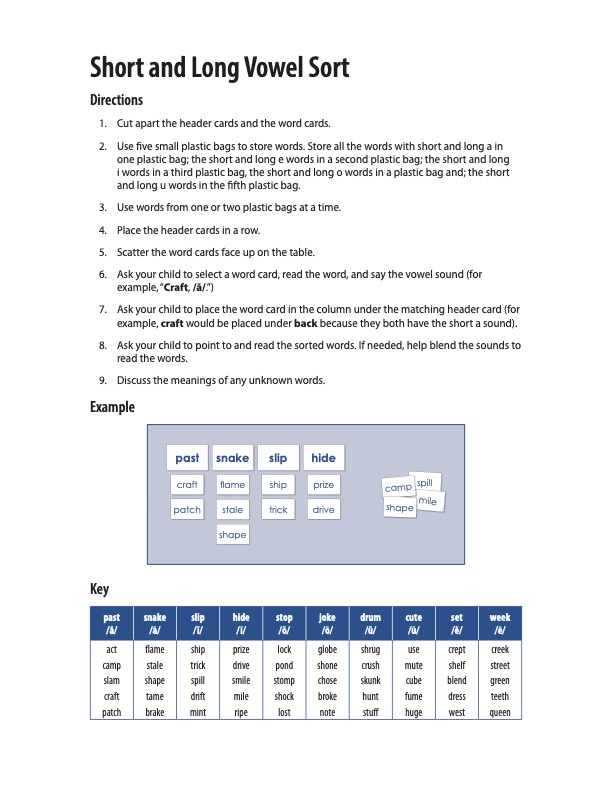
Short and Long Vowel Sort
Help your child identify short or long vowels and read words.
Fun With Consonant Blends and Digraphs
Key Points About the Video
- Mom explains that a digraph is two (or more) letters that make one sound (sh says /sh/).
- Mom explains that a consonant blend is two or more consonants next to each other that keep their individual sounds (You can hear the /s/ and the /l/ in the word sleep).
- When her son has difficulty with the /ch/ (as in chick), Mom models it for him and has him practice it several times.
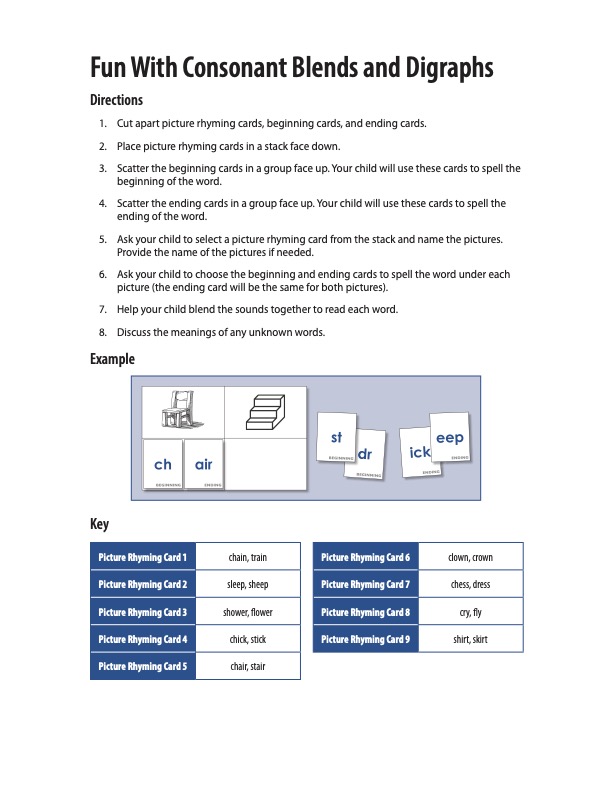
Fun With Consonant Blends and Digraphs
Help your child blend consonant blends and consonant digraphs from left to right to read a word. A consonant blend is two or more consecutive consonants that make their individual sounds (sl, gr, ft). A consonant digraph is two consecutive letters that are read as a single sound (ch, th, sh).
R-Controlled Vowel Sort
Key Points About the Video
- Dad reviews the r-controlled vowels on the activity sheet before they begin the activity.
- Dad provides positive feedback to his son: "Great job, buddy!"
- Dad uses words in a sentence to model oral language and help his son understand the word.
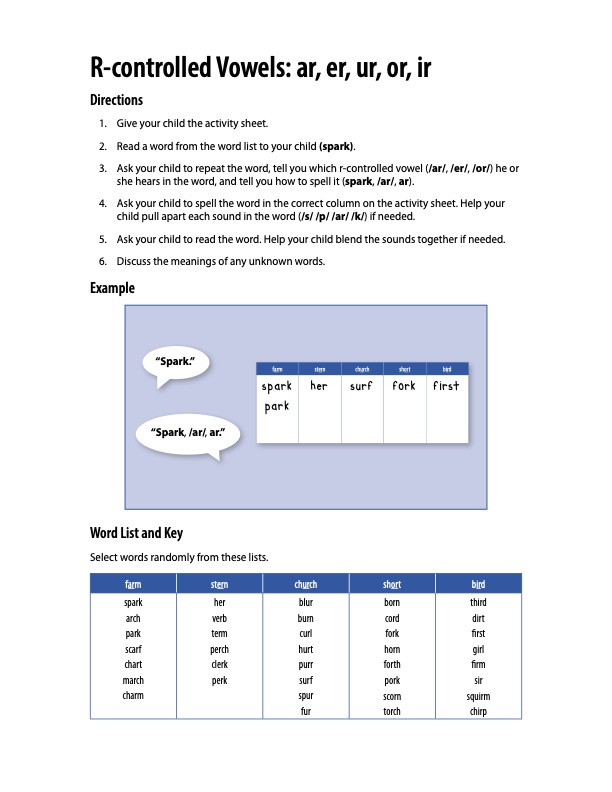
R-controlled Vowels: ar, er, ur, or, ir
Help your child identify r-controlled vowels (ar, er, ur, or, ir) in words and spell those words.
Sound-Spelling Patterns
For the following activities, your child will blend letters, analyze word parts, and write and recognize words. Use the documents below as needed before or while engaging in the activities.
Sound-spelling patterns consist of letters that are often combined to make a specific sound. Common sound-spelling patterns can include consonant patterns, vowel patterns, and syllable patterns. See examples below (not an exhaustive list of examples).
Syllable Pattern Examples
| Pattern Type | Pattern | Examples |
|---|---|---|
| Consonant Patterns | Consonant digraphs are two or more consonants next to each other that make one sound. |
th (this) sh (fish) tch (patch) |
| Consonant blends are two or more consonants next to each other that make their individual sounds. |
st (stop) ft (raft) scr (script |
|
| Silent-letter combinations are two consonants next to each other where one says its sound and the other is silent. |
kn (know) wr (write) mb (lamb) |
|
| Vowel Patterns | Vowel teams are two or more letters next to each other that say one vowel sound. |
ea (weak) igh (night) oa (boat) |
| Vowel diphthongs two vowels next to each other that begin with one vowel sound and changes to another vowel sound within the same syllable. |
ow (cow) oi (noise) |
|
| r-controlled vowels are vowels followed by r. |
ar (car) er (her) ir (sir) or (afford) us (fu) |
A syllable is a word part with a vowel in it. Usually, a word has as many syllables as it has vowels. Vowels are a, e, i, o, u. The other letters (like b, c, d, f) are consonants.
- Cat has one syllable.
- Picnic has two syllables (pic-nic).
- Yesterday has three syllables (yes-ter-day).
Syllable Pattern Examples
| Syllable Pattern | Description | Examples |
|---|---|---|
| Open | A syllable ending with a vowel sound that is spelled with a single vowel letter (a, e, i, o, or u). |
me pro/gram mu/sic |
| Closed | A syllable ending in one or more consonants and a short vowel sound spelled with one vowel. |
hat dish bas/ket) |
| VCe | V stands for vowel. C stands for consonant. e is the silent e at the end of a syllable or word. A syllable pattern that ends in silent e, which makes the vowel before it a long sound (say its name). |
stripe shine bake |
| Vowel Team | A syllable that has multiple vowels spelling the vowel. |
tooth pain train/er |
| Vowel-r | A syllable that has at least one vowel followed by an r. The r always comes directly after the vowel (ar, er, ir, or, ur). |
car bird cor/ner |
| Consonant-le | A final syllable that contains a consonant followed by le. The e is always silent in this syllable pattern. |
sim-ple puz-zle a-ble |
Floss Spelling Rule
Key Points About the Video
- Dad clearly explains the floss rule and provides examples at the beginning of the activity.
- Daughter uses her favorite color markers to complete the activity.
- After several practice opportunities, Dad asks his daughter to explain the difference between words that follow the floss rule and those that do not.
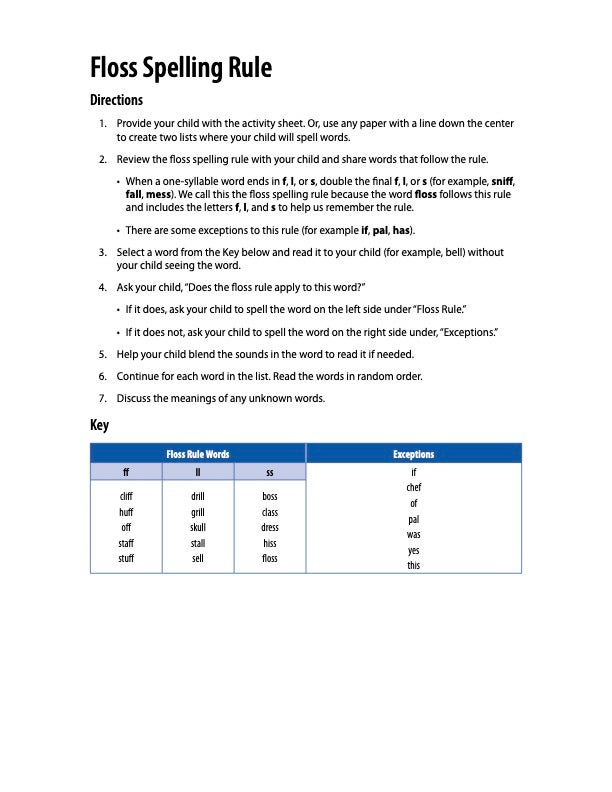
Floss Spelling Rule
Help your child practice the floss spelling rule. When a one-syllable words ends in f, l, or s, double the final f, l, or s (sniff, fall, mess). We call this the floss spelling rule because the word floss follows this rule and includes the letters f, l, and s to help us remember the rule.
Long Vowel Spelling Patterns
Key Points About the Video
- Mom explains and shows examples of long o spelling patterns before beginning the activity.
- Mom does the first one to show her daughter how the activity is to be completed.
- As each word is spelled by the daughter, Mom uses it in a sentence to promote vocabulary and oral language.
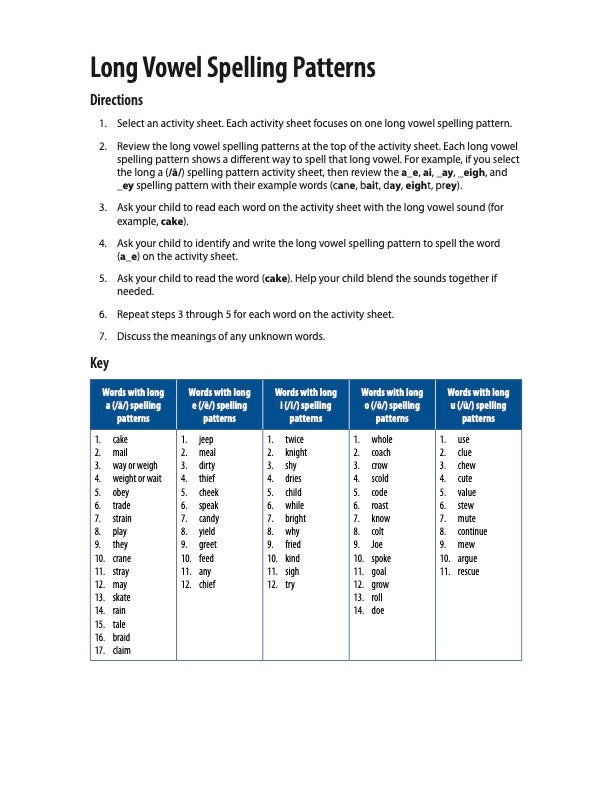
Long Vowel Spelling Patterns
Help your child identify long vowel spelling patterns and spell words.
Vowel Diphthong Bingo
Key Points About the Video
- Siblings have fun identifying vowel diphthongs while playing bingo.
- Oldest son engages both siblings in the activity.
- Oldest son encourages siblings to use the word in a sentence to promote language development.
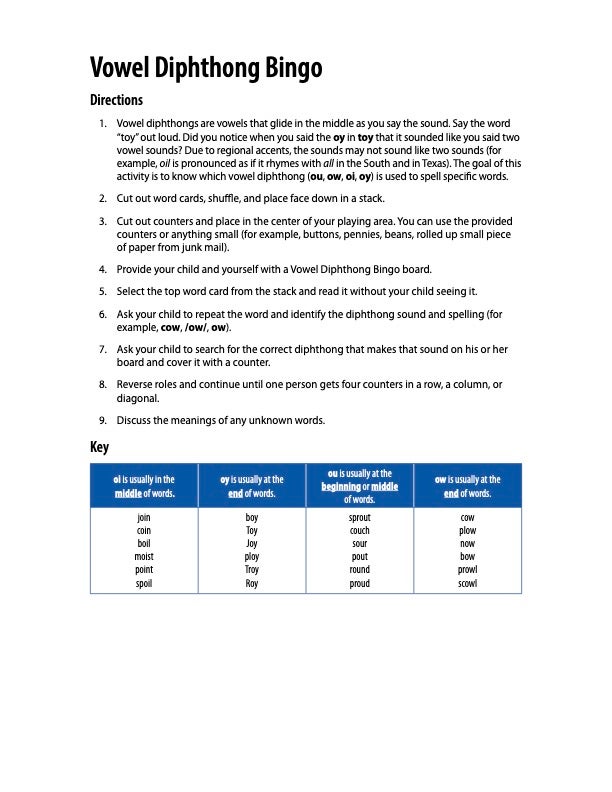
Vowel Diphthong Bingo
Help your child identify vowel diphthongs (ou, ow, oi, oy) in words.
Double the Consonant and Add -ing or -ed Spelling Rule
Key Points About the Video
- Mom explains the double the consonant spelling rule and provides examples at the beginning of the activity.
- Mom reviews the double the consonant rule with each word her daughter spells.
- Mom asks her daughter to use a word in the sentence to promote language and vocabulary development.
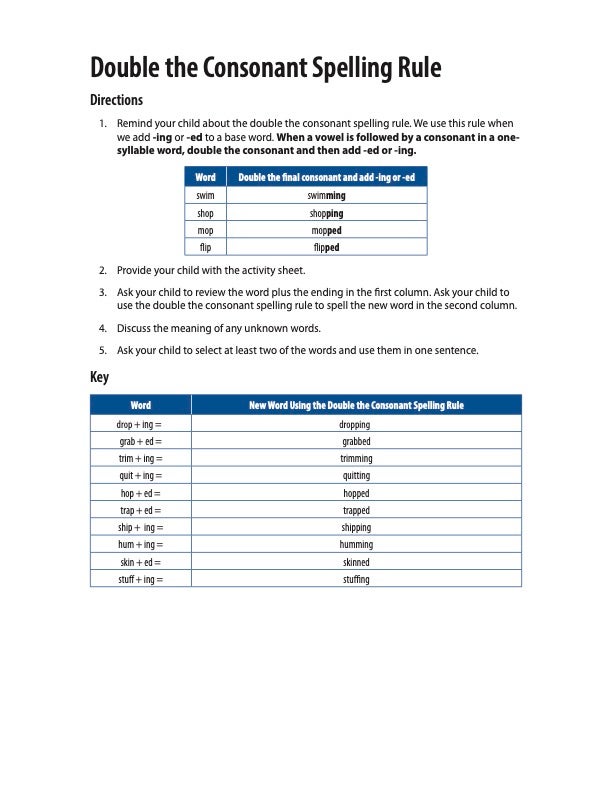
Double the Consonant Spelling Rule
Help your child practice the double the consonant spelling rule. We use this rule when we add -ing or -ed to a word. When a vowel is followed by a consonant in a one-syllable word, double the consonant and then add -ed or -ing (swim/swimming, shop/shopping, mop/mopped).
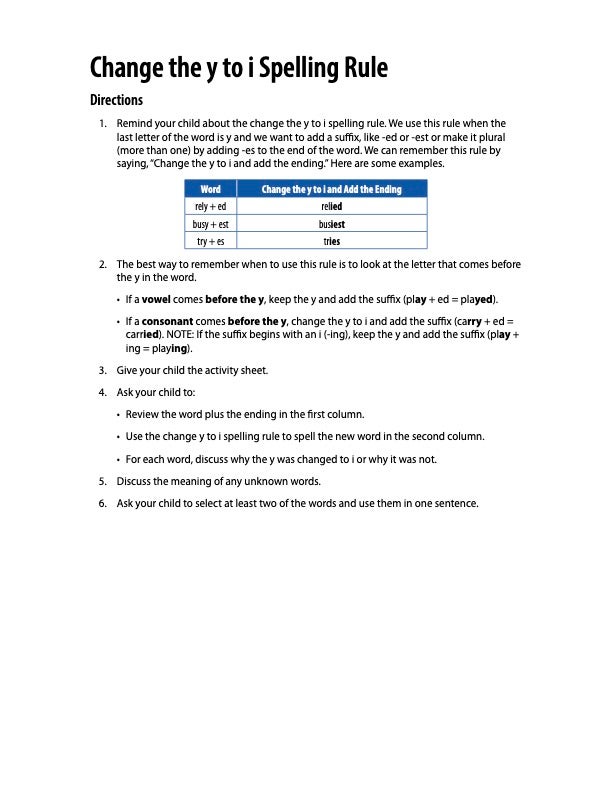
Change the y to i Spelling Rule
Help your child practice the "change the y to i and add the ending" spelling rule (rely + ed = relied).
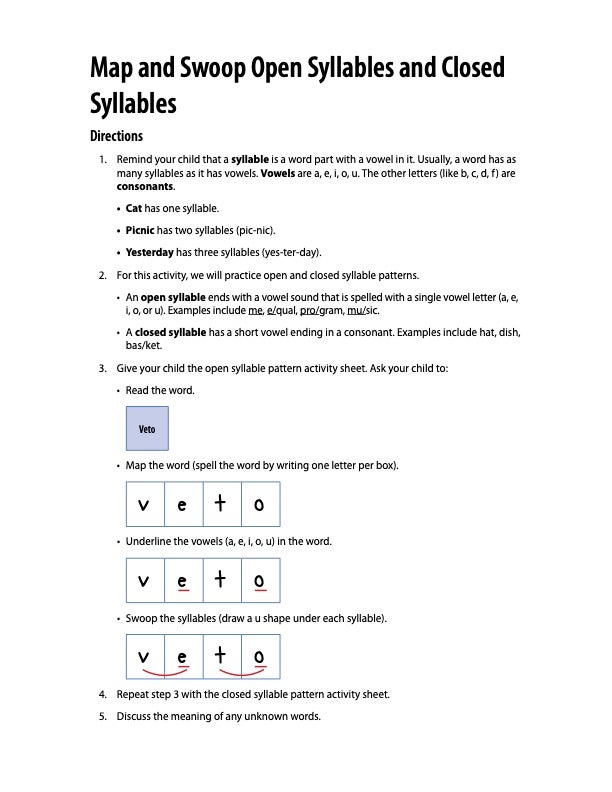
Map and Swoop Open Syllables and Closed Syllables
Help your child identify open and closed syllable patterns to read and spell words. An open syllable ends with a vowel sound that is spelled with a single vowel letter (a, e, i, o, or u). Examples include me, pro/gram, mu/sic. A closed syllable has a short vowel ending in a consonant. Examples include hat, dish, bas/ket.
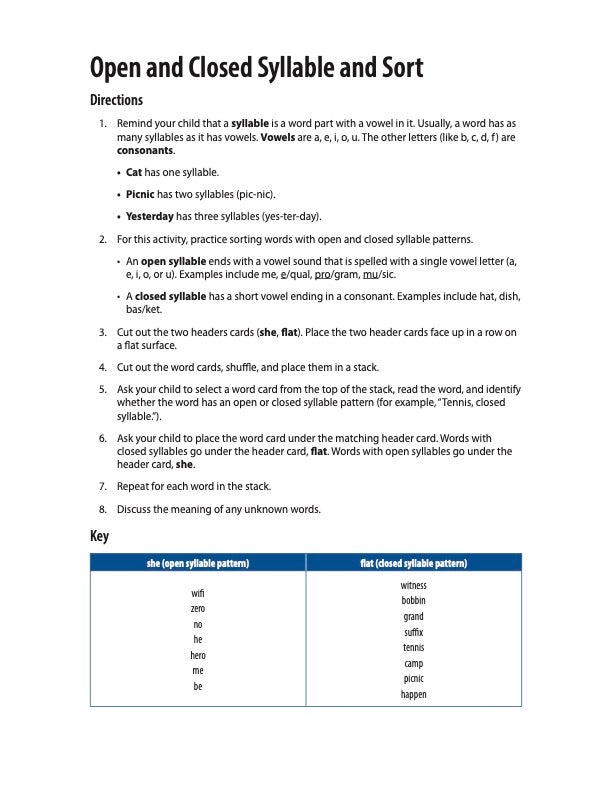
Open and Closed Syllable and Sort
Help your child identify and sort words with open and closed syllable patterns.
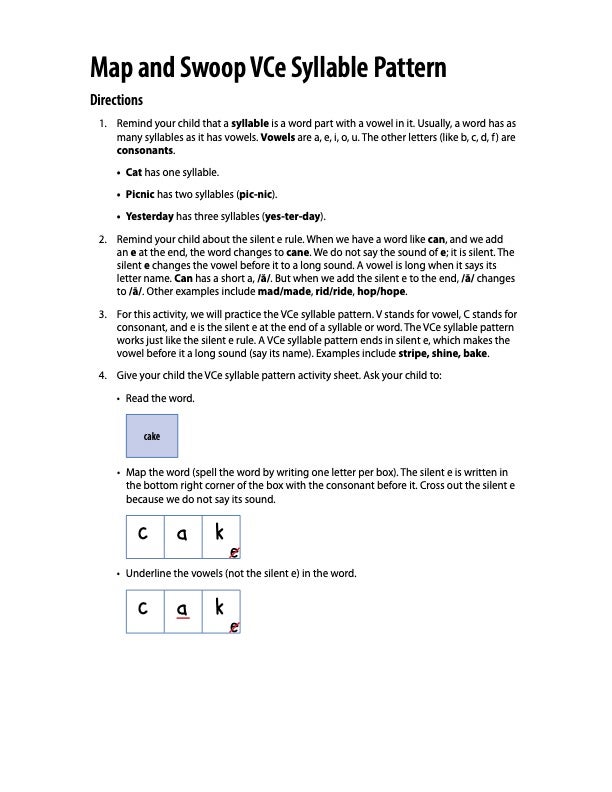
Map and Swoop VCe Syllable Pattern
Help your child identify VCe syllable patterns to read and spell words. A VCe syllable pattern ends in silent e, which makes the vowel before it a long sound (say its name). Examples include stripe, shine, bake.
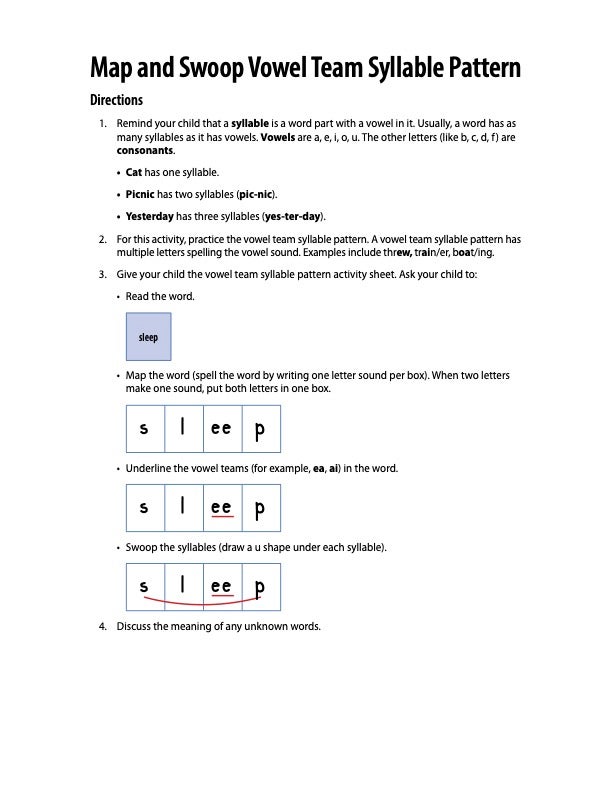
Map and Swoop Vowel Team Syllable Pattern
Help your child identify the vowel team syllable pattern to read and spell words. A vowel team syllable pattern has multiple vowels spelling the vowel. Examples include train/er, boat/ing.
Vowel Team Syllable Pattern Practice
Key Points About the Video
- Dad discusses what vowel teams and syllables are to make sure his son understands before starting the activity.
- Dad is patient and encouraging ("you're doing a great job") throughout the activity.
- Dad points out and explains the "tricky" words (boatload, toenail). These words are compound words, and each include two vowel team syllables.
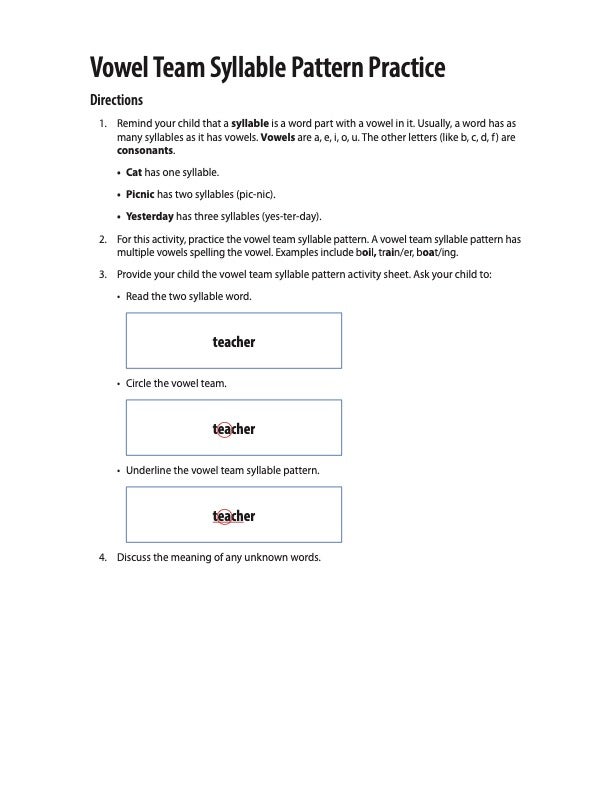
Vowel Team Syllable Pattern Practice
Help your child identify the vowel team syllable pattern in words.
Map and Swoop Vowel-r Syllable Pattern
Key Points About the Video
- Mom explains vowel-r syllable patterns before beginning the activity.
- Mom explains the meanings of unknown words (cursor) to promote vocabulary development.
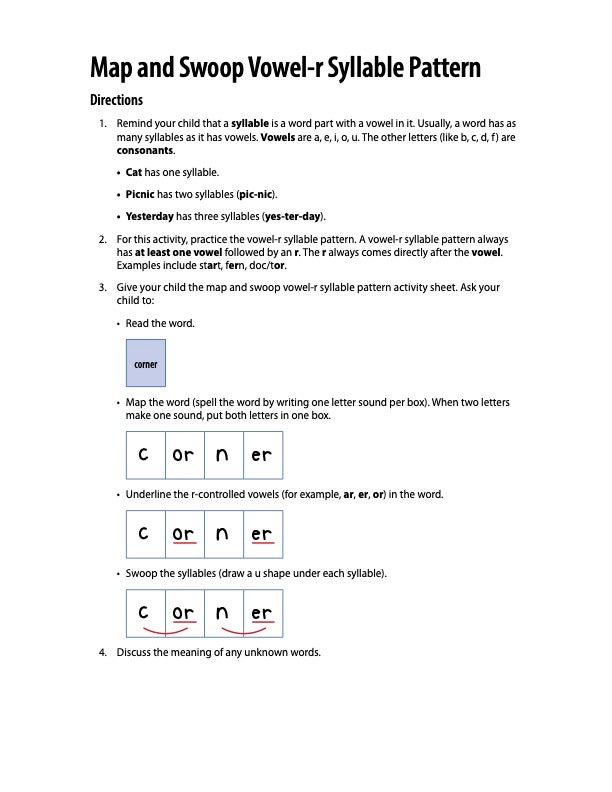
Map and Swoop Vowel-r Syllable Pattern
Help your child identify the vowel-r syllable pattern in words. A vowel-r syllable pattern always has at least one vowel followed by an r. The r always comes directly after the vowel. Examples include start, learn, doc/tor.
Common Word Parts
Understanding common word parts like base words, prefixes, and suffixes will help children break words into smaller, meaningful word parts, which can help them read, write, and understand more challenging words.
The word help is called a base word because it can stand alone and has meaning. It is also called a base word because we can add to it to change the word. For example, we can add the ending -ful, for the word helpful. When we add a word part to the end of a word, it is called a suffix. We can also add a word part to the beginning of a base word. When we add a word part to the beginning of a base word, it is called a prefix. For example, the prefix un- can be added to helpful to make the word unhelpful.
| Word | = | Prefix | + | Base Word | + | Suffix |
|---|---|---|---|---|---|---|
| Unhelpful | = | un | + | help | + | ful |
Base Words and Inflectional Endings
Key Points About the Video
- Mom reviews what they started before dinner to remind her son of what the activity was all about.
- Mom asks her son the meaning of the inflectional endings -es and -ed to make sure he understands the meaning of the words they review.
- Mom prompts her son by asking him to say the whole word, the base word, and the inflectional ending.
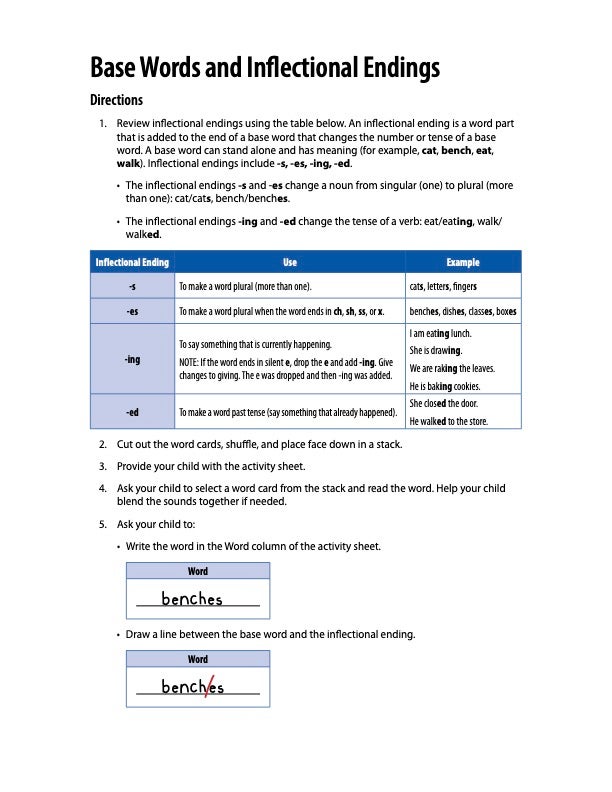
Base Words and Inflectional Endings
Help your child break words into base words and endings.
Contraction Bingo
Key Points About the Video
- When her daughter doesn't find I've, Mom tells her that it will have an I first to help her find the contraction.
- Mom has her daughter read the word cards and asks her what contraction makes up the words.
- Mom encourages her daughter to look on both bingo cards to find the contraction to provide more practice opportunities.
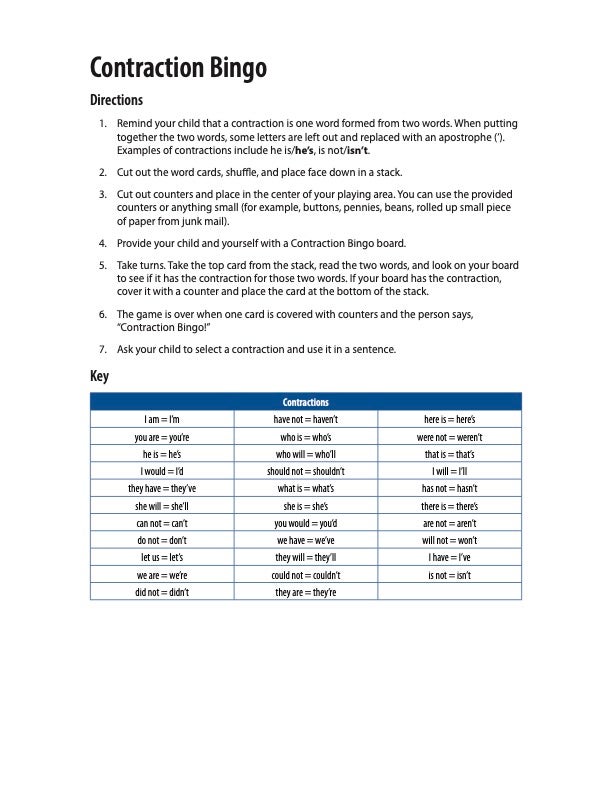
Contraction Bingo
Help your child practice identifying the words that make up contractions.
Prefix or Suffix?
Key Points About the Video
- Mom discusses the meaning of each word to promote vocabulary development.
- When her daughter can't remember the word prefix, Mom gives her a choice, "Is it a suffix or a prefix?"
- Mom and daughter enjoy painting and reading words with prefixes and suffixes.
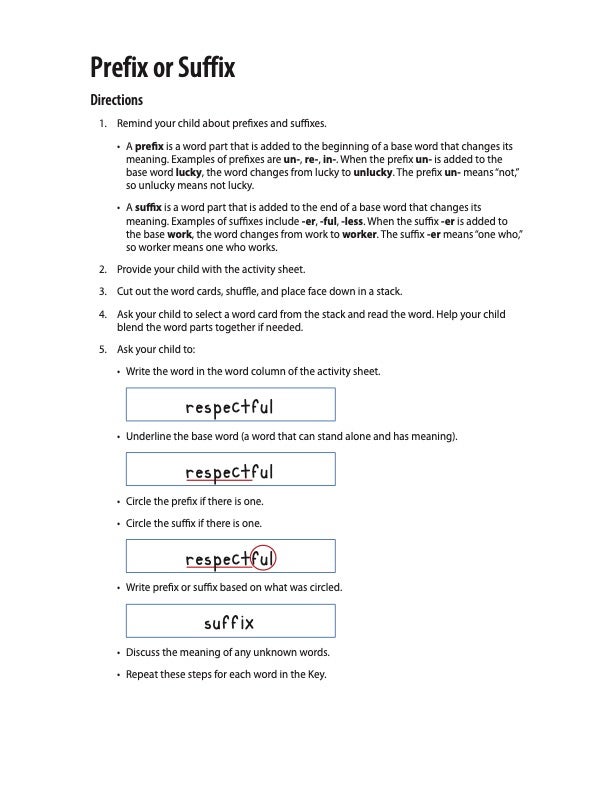
Prefix or Suffix
Add your text here. For instructions on using this template, visit: WYSIWYG Templates
Help your child identify prefixes and suffixes.
Reading Words
Blending is the ability to put sounds together to read a word. For example, when children see the word soil, they are able to say, "/s/, /oi/, /l/, soil." There are many ways to support your child in reading words. For example, provide opportunities for your child to practice reading words in a list or on flashcards. It is also important for children to practice reading words in sentences and stories.
Let's Read!
Key Points About the Video
- When her son encountered a difficult word, Mom encouraged him to separate the word into individual sounds (still) or parts (badly) and then read the whole word.
- Mom talks about important vocabulary (tour, caught her eye) in the story.
- Mom asks her son questions about what he read to encourage language development and ensure he understood what he read.
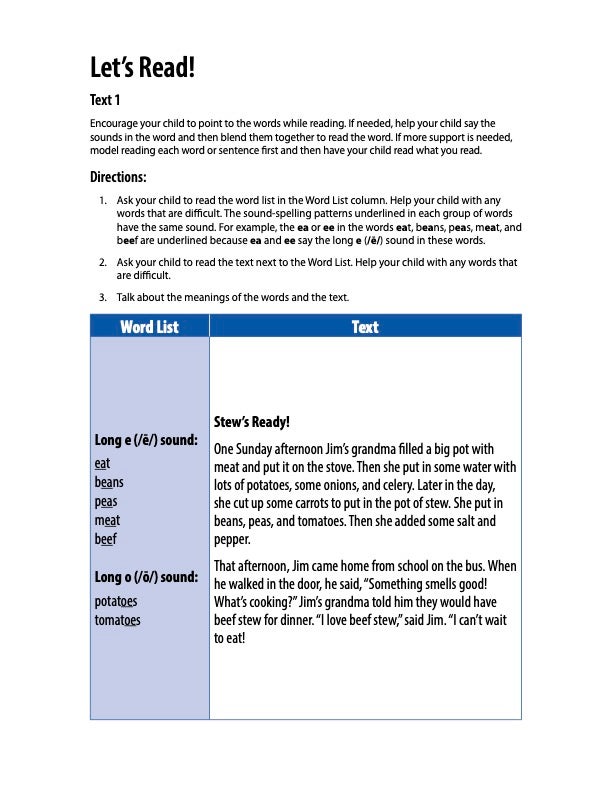
Let’s Read! Text 1
Help your child read words in a list and then read text that contains these words.
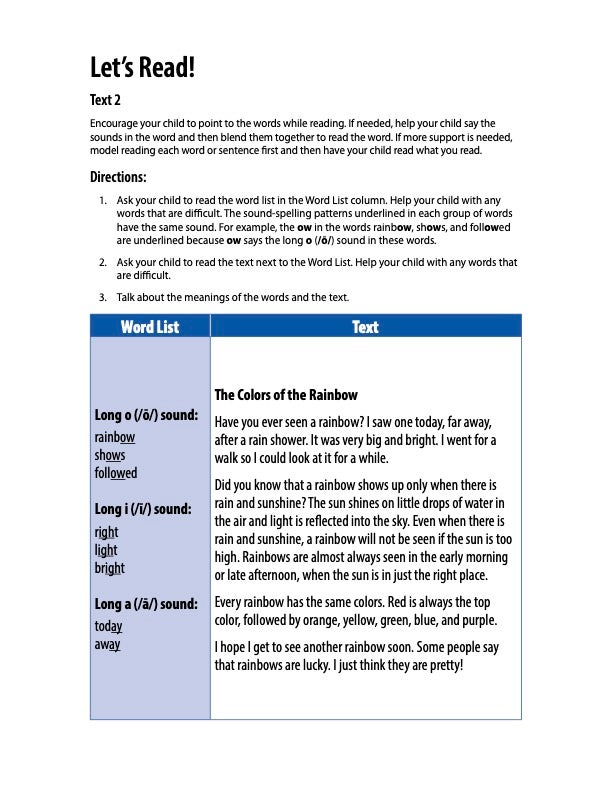
Let’s Read! Text 2
Help your child read words in a list and then read text that contains these words.
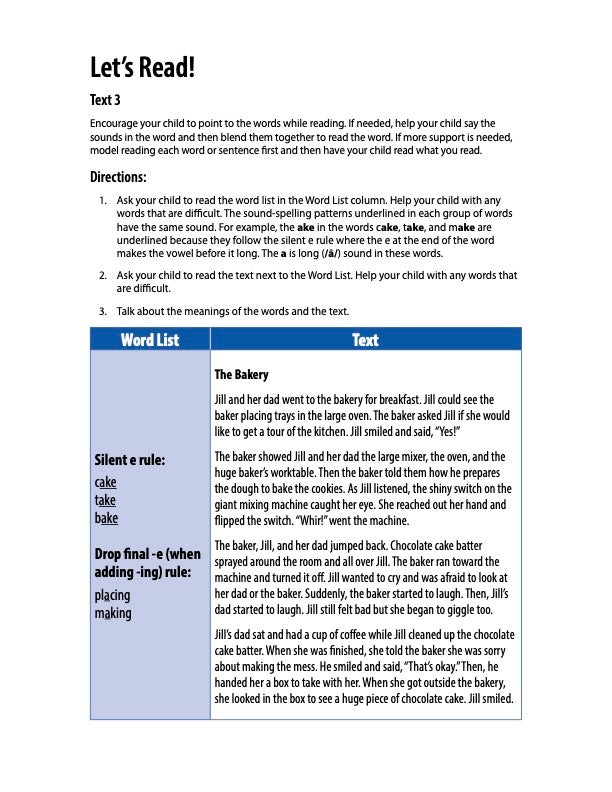
Let’s Read! Text 3
Help your child read words in a list and then read text that contains these words.
High-Frequency Words
High-frequency words are words that appear often in books, like again, every, know, and could. It is important that children learn how to read high-frequency words automatically, correctly without hesitation. The more your child reads and writes high-frequency words, the better he or she will get at reading them automatically.
There are many activities that families can do to help their children read high-frequency automatically.
- Show your child the high-frequency word because. Have your child say the word, write the word, and then say the word again.
- Use the provided high-frequency word cards as flash cards and time your child as he or she reads a stack of them. You can place words that were challenging for your child in a separate pile, so you know which words need more practice. The goal is to read more words correctly in less time each time you engage in the activity.
Read and Spell High-Frequency Words
Key Points About the Video
- Dad provides several opportunities for his daughter to read and spell each word.
- Daughter uses her favorite color markers to complete the activity.
- Dad has his daughter write a sentence using high-frequency words of her choice to provide more practice opportunities.
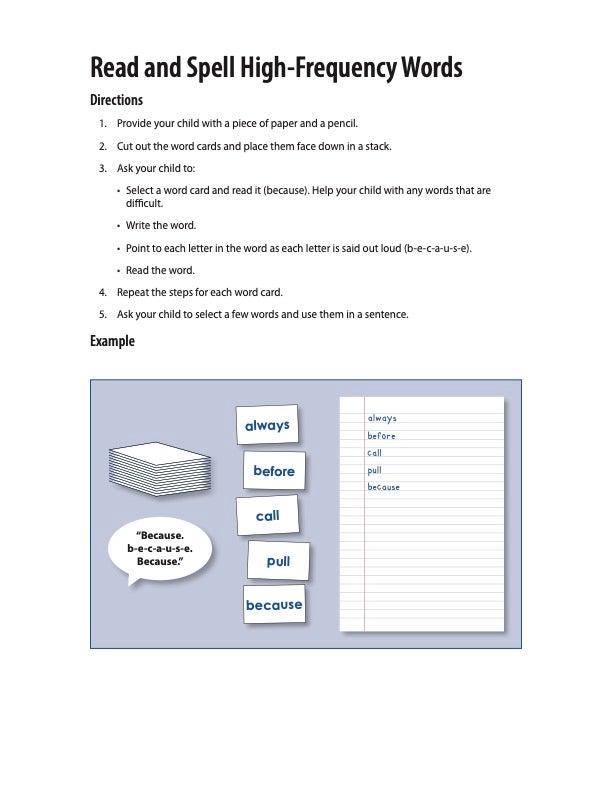
Read and Spell High-Frequency Words
Help your child practice high-frequency words (always, because).
Challenging and Important Words
Just because a book contains challenging words, it doesn't mean that you can't read it with your child. Before reading a book with your child, skim it to see if there are any challenging and important words. For example, Tyrannosaurus rex would be considered challenging to read, but are important words in a book about dinosaurs. Words also may be challenging because the child has not learned the sound-spelling pattern contained in the word or the word contains irregular sound-spelling patterns as in the words resource or necessary. Select three such words that appear most frequently in the book. Introduce the words to your child before you read the book. Point to each word in the book and tell your child how to pronounce it and what it means. Ask your child to point to the word and say it. If there are too many challenging words, you can read the book aloud to your child rather than have him or her read it to you.
Challenging and Important Words
Key Points About the Video
- Mom reviews the main idea of the book since they are reading the book over several days.
- Mom reviews three challenging and important words (independent, razor, treasure) and relates them to something familiar to her son before reading.
- When the challenging and important words appear as they read, Mom asks her son what they mean.
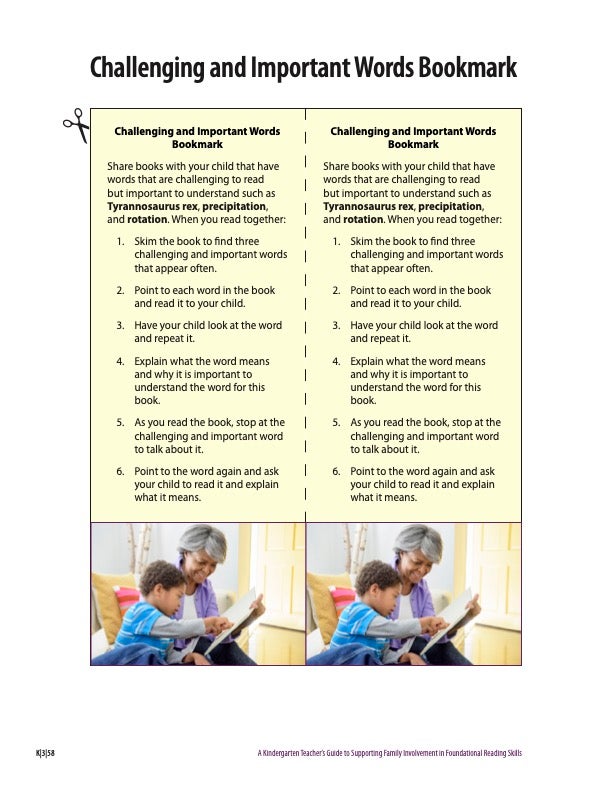
Challenging and Important Words Bookmark
Follow the steps on this bookmark to discuss challenging and important words with your child as you read books together.
Books to Share
Use the provided bookmark as a reminder to talk about challenging and important words that appear often in the book (see suggested books below).
- Emperor Penguins by Roberta Edwards
- Your Fantastic Elastic Brain by JoAnn Deak
- Fly Guy Presents: Dinosaurs by Tedd Arnold
- Pet Heroes by Nicole Corse
Second Grade: Reading for Understanding
Accurate and Efficient Word Identification
Support your child in reading accurately, at a conversational pace, and with expression so they understand what they read.
As your child practices reading out loud, it is important to help him or her to read words correctly and quickly. When children can read words accurately and fairly quickly, they can focus their attention on understanding what they are reading instead of trying to identify each word.
There are two important things families can do to help their child read words correctly and quickly.
- Read out loud to your child every single day! Reading to your child can be a special time to spend together. It will show him or her that reading is important and fun! Reading aloud will help your child understand what reading should sound like, and provides a model of how to read words correctly, quickly, and with expression! Reading with the right expression means that you are talking like the characters in the book--your voice sounds excited when the character is excited or sad when the character is sad.
- Encourage and help your child as he or she reads out loud. You may need to help your child when she or he comes to a word that is difficult to read. You might provide a reminder by saying, "Let's say each part of this word and the put the parts together to read it." Any reminder that encourages your child to use what he or she already knows to figure out the word can be helpful. As you read with your child, remember to be patient as reading is a skill that takes a lot of practice. Be sure to let your child know that you are proud of his or her progress! The support and encouragement you give your child will help him or her improve in reading.
When choosing books for your child to read out loud, select books that are of interest to your child, are not too easy or too hard, and are linked to his or her experiences or concerns. For instance, if your child is interested in animals or is afraid of the dark, it can be helpful to select books on those topics.
When You Read to me (Happy Birthday, Danny and the Dinosaur!)
Key Points About the Video
- Mom encourages her son to use his finger to point to the words as he reads.
- Mom helps her son read challenging words (helped, song) by modeling how to read them and then asks him to read the sentence again for another opportunity to practice.
- Mom and son have fun talking about the book.
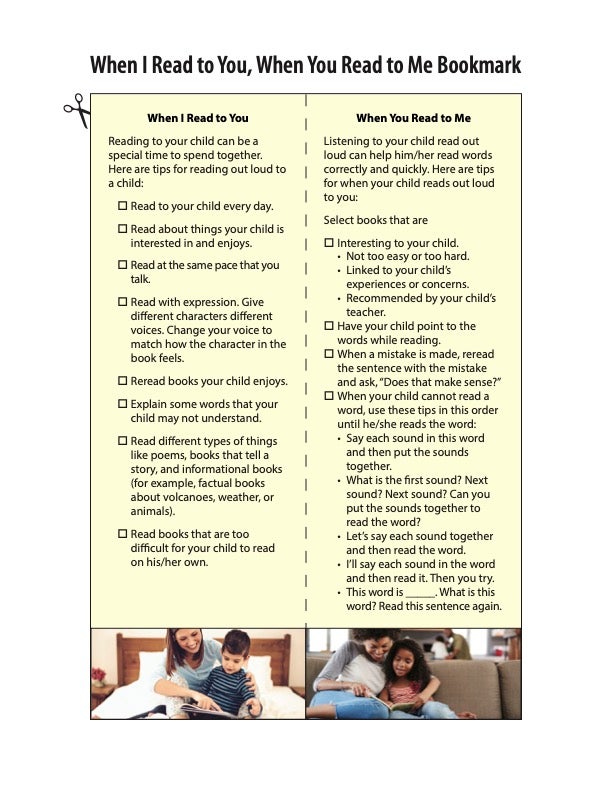
When I Read to You, When You Read to Me Bookmark
On one side of this bookmark are tips to use as you read out loud to your child. On the other side are tips for when your child reads out loud to you.
Books to Share
Suggested informational books that you can read to your child to model reading words correctly, at a conversational pace, and with expression.
- Emperor Penguins by Roberta Edwards
- Your Fantastic Elastic Brain by JoAnn Deak
- Fly Guy Presents: Dinosaurs by Tedd Arnold
- Pet Heroes by Nicole Corse
Recognizing Misread Words and Correcting Errors
Experienced readers know when their reading does not make sense because they have misread a word. Once they realize they misread a word, experienced readers can correct their mistake. Beginning readers don't always notice when they misread a word because they don't always pay attention to what they are reading. Therefore, it is important to show children how to recognize misread words when they read. A reader should think about what he or she is reading and decide whether it makes sense or not, that is, self-monitor. We also need to show children how to self-correct when they misread a word. Improving the ability to self-monitor and self-correct will help children understand what they read and become better readers.
Families can help children monitor what they read and make corrections when words are misread. As you read to your child, you can provide examples of how to recognize when words are misread by "thinking out loud." You can say things like, "That didn't make sense. I'm going to read that sentence again." When your child reads to you and misreads a word, ask her to stop and see if she can correct the error. If not, reread the sentence with the missed word exactly how your child read it and ask, "Did that make sense?" If your child does not self-correct, read the word and have her reread it. Then have her read the sentence correctly.
Does That Make Sense?
Key Points About the Video
- When a word error is made, mom reads the sentence as her son read it and asks, "Does that make sense?" to provide her son an opportunity to self-correct.
- Mom has her son reread missed words correctly and then read the whole sentence again.
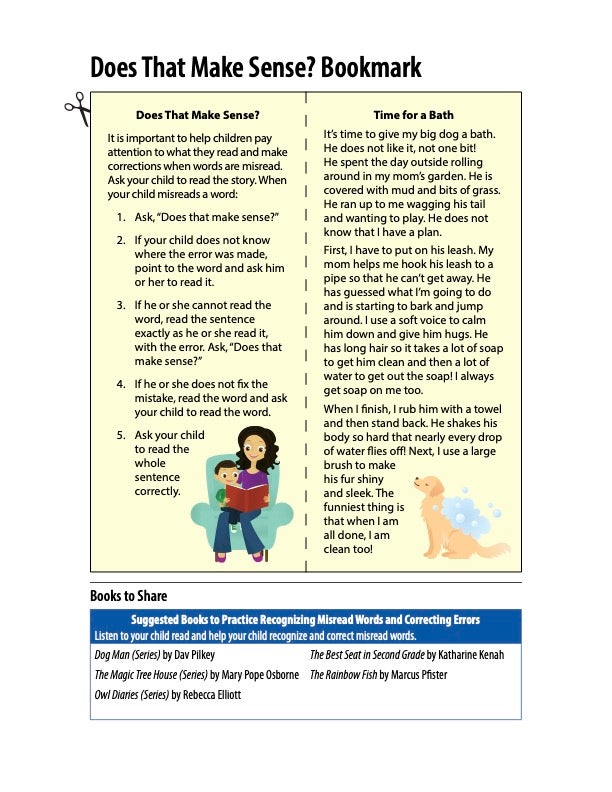
Does That Make Sense Bookmark
Help your child pay attention to what they read and self-correct when a word is misread.
Books to Share
Suggested books for your child to read out loud to you while you help your child recognize and correct misread words.
- Dog Man (Series) by Dav Pilkey
- The Magic Tree House (Series) by Mary Pope Osborne
- Owl Diaries (Series) by Rebecca Elliott
- The Best Seat in Second Grade by Katharine Kenah
- The Rainbow Fish by Marcus Pfister
Oral Reading Practice
Oral reading practice is when children read out loud. It is very important that children in second grade have many opportunities for oral reading practice with a proficient reader that listens and offers help when needed. As children read out loud, they get better at reading words correctly, quickly, and with the right expression (fluently). Reading words quickly means reading them at the same pace in which we talk. When you read with the right expression, you understand what commas, periods, and question marks mean. Reading with expression shows that you understand what you read when you, for example, change your voice to be excited when a character is excited. When children read fluently, they can focus their attention on understanding what they read, rather than trying to figure out how to read the words. The more children practice reading out loud with support, the better readers they will become!
There are many ways to support your child in oral reading practice. You can echo read and read together.
- Echo reading means the more proficient reader reads part of a book out loud and then the child reads the same part out loud. Thus, the child echoes what you read. As you echo read with your child, make sure that he or she follows along while you read by looking at the words as you read them. Your child should point to the words as he or she reads the same thing you read. This is to make sure your child is paying attention to the words and not just repeating what you say.
- Reading together means you and your child read the same thing out loud at the same time. When you read at the same time, make sure your child follows along by pointing to each word. You can slow your pace of reading down a little when you read at the same time. Always offer positive encouragement and let your child know how proud you are because he or she is practicing reading.
The encouragement and support children receive as they read out loud will help them become more fluent and confident readers. Be patient as children learn to read and remind them often of how proud you are of them for practicing reading.
Echo Reading (Danny and the Dinosaur and the New Puppy)
Key Points About the Video
- Mom models reading with expression, which is an important part of reading fluently.
- Mom praises son for using expression (different voices for different characters) as he reads.
Reading Together (Danny and the Dinosaur and the New Puppy)
Key Points About the Video
- Mom slows her pace of reading a little so they can read at the same time.
- Mom uses her finger to point to the words as they read together.
- Mom reads with expression, an important part of reading fluently.
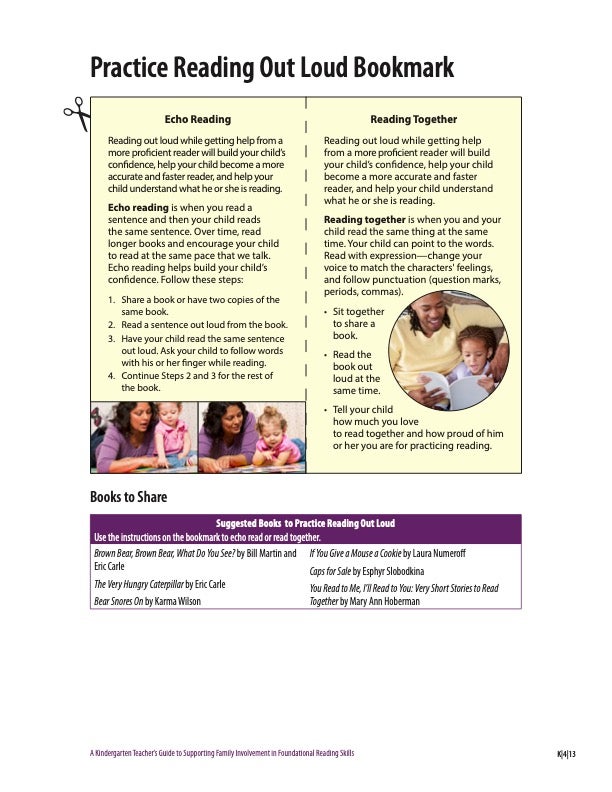
Practice Reading Out Loud Bookmark
Use this bookmark as a reminder of the importance of reading every day with children. One side of the bookmark describes Echo Reading and the other side describes Reading Together.
Books to Share
Suggested books for your child to read out loud to you as you Echo Read and Read Together.
- The Magic School Bus Series by Joanna Cole
- Waiting is Not Easy! by Mo Willems
- The Book With No Pictures by B.J. Novak
- The Day the Crayons Quit by Drew Daywait
- Oh Say Can You Say What's the Weather Today?: All About Weather (Cat in the Hat's Learning Library) by Tish Rabe
The Family Activities were excerpted from A Second Grade Teacher's Guide to Supporting Family Involvement in Foundational Reading Skills, which include Second Grade Videos.